Your website looks fine. The pages load. The contact form works. But leads from Google? Barely any.
This is the situation most small business owners find themselves in, and the frustrating part is that nothing looks "broken." There's no error message telling you what's wrong. The problem is invisible from the surface.
That's exactly what an SEO audit is designed to uncover. It's the diagnostic step that answers the question most business owners are afraid to ask: is my website actually set up to be found online? If you've been wondering why your competitors keep showing up in Google and you don't, the answer is almost always sitting inside an audit.
At JG DigitalHub, I've run SEO audits for local businesses in Bacolod and Negros Occidental and for clients in the US, UK, and Australia. In every case, the audit surfaced fixable issues that were quietly holding the site back. Here's what you need to know.
What Is an SEO Audit?
An SEO audit is a structured review of your website's technical health, on-page optimization, content quality, local signals, and backlink profile. It identifies what's stopping your site from ranking in Google and delivers a prioritized action plan so you know exactly what to fix first.
Think of it like a car inspection. Your car might start every morning and feel perfectly normal to drive, but a mechanic can spot worn brake pads, a weak battery, and an oil leak you'd never notice on your own. An SEO audit works the same way. It goes deeper than anything a business owner can see from the browser.
The key difference between an audit and "just looking at the site" is structure and measurement. An audit uses crawling tools, analytics data, and Search Console reports to surface issues that are completely invisible on the front end. It doesn't just describe problems. It ranks them by impact so you know what to tackle first.
What Does an SEO Audit Actually Cover?
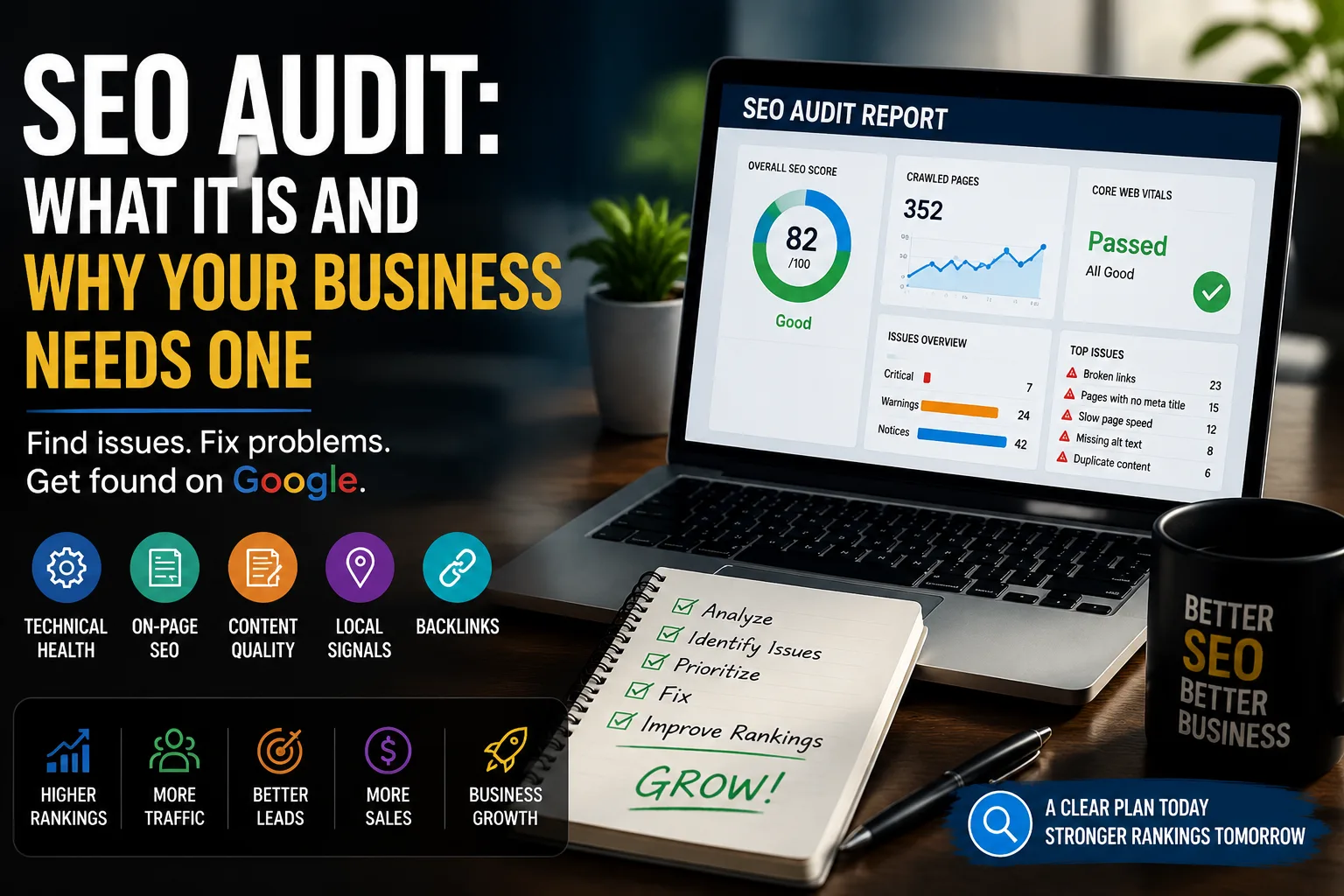
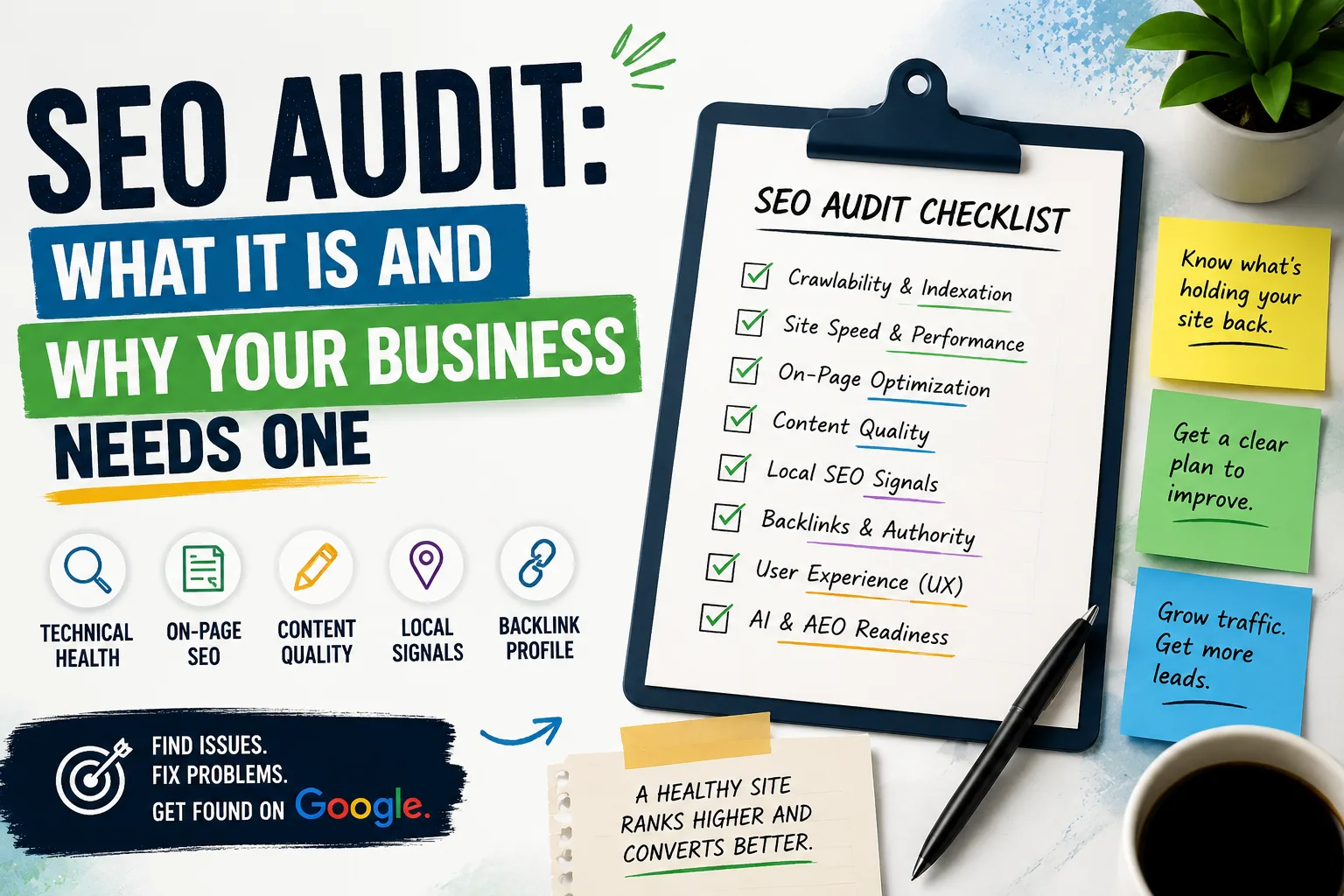
A comprehensive SEO audit covers five core areas: technical health (crawlability, indexation, site speed), on-page optimization (title tags, headings, meta descriptions), content quality (relevance, depth, keyword targeting), local signals (Google Business Profile, NAP consistency), and backlinks (quality, quantity, and any toxic links pointing at your site).
A rigorous technical audit framework breaks the technical phase alone into five stages: crawlability, rendering, site architecture, indexation, and performance. Each stage can surface its own blockers. A page that Google can't crawl will never rank, regardless of how well the content is written.
Audit categories also include local SEO signals and domain authority, which matter especially for service businesses targeting a specific city or region. If you want to show up when someone in Bacolod searches for your service, your local signals need to be solid from the ground up.
One area most agencies aren't checking yet but should be: 2026 audits need to include an AI and AEO readiness check. This means reviewing whether your content is structured so that AI answer engines like Google's AI Overviews, ChatGPT, and Perplexity can extract and cite your pages. Schema markup, clear answer formatting, and factual density all contribute here.
Here's a quick breakdown of the five audit areas:
- Technical: Crawl errors, broken links, page speed, mobile usability, HTTPS status
- On-page: Title tags, meta descriptions, heading structure, keyword placement (my on-page SEO checklist covers what to look for here)
- Content: Thin pages, duplicate content, keyword targeting gaps, content freshness
- Local: Google Business Profile accuracy, NAP consistency, local schema (see my Google Business Profile setup guide for a step-by-step walkthrough)
- Performance: Core Web Vitals, image optimization, caching (my speed optimization breakdown goes deeper on this)
6 Signs Your Website Needs an SEO Audit
Your website needs an SEO audit if any of these apply: organic traffic has plateaued or dropped, you've never had an audit done, you're planning a site redesign, your rankings slipped after a recent change, local competitors consistently outrank you, or you can't identify which pages are generating leads.
Traffic decline and ranking drops are the most common triggers for an audit, and for good reason. These signals mean something changed, either on your site or in Google's algorithm, and you need data to know which.
Traffic has plateaued or dropped
Google Analytics shows flat or declining organic traffic over 3 to 6 months with no obvious explanation.
You've never had an audit
If your site has been live for more than a year and has never been audited, there are almost certainly fixable issues holding it back.
You're planning a redesign
Rebuilding without an audit first risks carrying old SEO problems into the new site, or breaking what's already working.
Rankings dropped after a change
New plugins, a theme switch, or a content update can cause unintended ranking drops. An audit identifies the cause.
Local competitors consistently outrank you
If businesses with weaker brands keep appearing above you in local results, their local SEO signals are stronger than yours.
You don't know which pages drive leads
If you can't point to the pages generating inquiries, you're operating without the data you need to invest wisely.
What Happens After the Audit? The Action Plan
After an SEO audit, you receive a prioritized report that ranks every issue by impact and effort, not just a raw list of problems. The highest-priority fixes — those with the biggest ranking impact and the lowest implementation difficulty — go at the top so you know where to start.
Modern audits should connect every finding directly to business outcomes, not just technical scores. Fixing a missing meta description matters less than fixing a page that could rank on page one for a high-intent keyword with better structure. A good audit report shows you that distinction clearly.
Once you have the report, you have two paths: implement the fixes yourself (suitable for straightforward on-page and content issues) or hire someone to handle implementation. If the audit reveals structural or speed problems that go deep, a rebuild is sometimes the smarter investment. In those cases, WordPress web design services that bake SEO best practices into the build from day one are worth a look.
The action plan is what separates a useful audit from a document that sits in a folder. It tells you what to do, in what order, and why.
How Much Does an SEO Audit Cost?
For most small business websites, a professional SEO audit costs between $300 and $600. Larger sites with hundreds of pages, multiple locations, or e-commerce functionality cost more, typically $800 to $1,500 or higher, because there is simply more to analyze and prioritize.
What drives the range within small business pricing is site complexity: how many pages exist, how many technical issues are likely, whether local SEO is a major component, and how detailed the deliverable report needs to be.
Compared to an ongoing SEO retainer, which typically starts at $500 to $1,000 per month, a one-time audit is a low-risk way to understand exactly where you stand before committing to monthly investment. It answers the question first, then gives you the data to decide whether ongoing work makes sense.
Details and pricing for my SEO audit package are on the services page if you want a clear picture of what's included.
SEO Audit vs. Ongoing SEO: What's the Difference?
An SEO audit is a one-time diagnosis that identifies what's wrong and what to fix. Ongoing SEO is the continuous work of implementing those fixes, publishing new content, building links, and monitoring performance over time.
The audit tells you where you are. Ongoing SEO moves you to where you want to be. Both matter, but they serve different purposes and the right starting point depends on where your site currently stands.
A one-time audit is sufficient if your site is in reasonable shape and you need a clear baseline and a list of fixes you can implement in-house. Monthly management makes more sense if you're targeting competitive local keywords, growing your content library consistently, or want regular reporting and adjustments as search results shift.
A quarterly audit cadence is recommended even when ongoing SEO work is already in place. Search results change, competitors adjust their strategies, and new technical issues emerge over time. A quarterly check catches problems before they compound.
Why an SEO Audit Matters More Now, in the Age of AI Search
SEO audits are more important in 2026 than they have ever been because the way people find businesses online is shifting fast, and most websites aren't structured to keep up.
AI Overview click-through rates rose from 1.3% to 2.4% between December 2025 and February 2026, a signal that users are engaging more with AI-generated answers at the top of search results. The problem is that when AI Overviews appear, organic clicks on the same queries drop by an average of 38%. That's real traffic going elsewhere.
Position one click-through rates have dropped 32% year over year, and clicks are spreading further down the page as users scroll past AI-generated summaries. For local businesses, there's some good news: AI Overviews appear in only about 7% of local searches. Local intent queries are still dominated by traditional results, which means local SEO fundamentals still have strong ROI.
"This is exactly why I recently ran a structured data audit on jgdigitalhub.com and updated schema markup across key pages: telephone, address, areaServed, and FAQ schema. The audit flagged that my structured data was incomplete. Fixing it improved how Google and AI engines interpret and display my business information in search results. That's not a hypothetical benefit; it's the kind of specific, actionable fix a proper audit surfaces."
In 2026, an audit that doesn't check your AI readiness and answer engine optimization is leaving a significant gap in your strategy.
Conclusion
An SEO audit isn't about finding blame or proving your website is bad. It's about getting a clear, prioritized roadmap so you stop guessing and start fixing the right things in the right order.
Whether your traffic has stalled, you've never had an audit, or you're about to rebuild your site, the audit is always the right starting point. It gives you the data to make confident decisions about your website and your SEO investment going forward.
If you're ready to find out exactly where your website stands, book an SEO audit and I'll get back to you within 24 hours.
Frequently Asked Questions
How long does an SEO audit take?
A professional SEO audit for a small business website typically takes 1 to 2 weeks from start to delivered report. This includes the technical crawl, data analysis, and writing a prioritized action plan. Larger or more complex sites take longer. Avoid services that promise an instant audit — automated tools alone don't catch on-page, content, or local SEO issues accurately.
Can I do an SEO audit myself?
You can audit some basics using free tools like Google Search Console, PageSpeed Insights, and the free tier of Screaming Frog. But interpreting the data, prioritizing what matters most, and identifying patterns across technical, content, and local signals requires experience and judgment. A DIY audit is a useful starting point but typically misses the issues with the biggest ranking impact.
How often should I get an SEO audit?
For most small businesses, once a year is a reasonable minimum. If you're actively publishing content, running paid ads, or competing in a local market with strong competitors, a quarterly audit makes more sense. You should also audit immediately after any major site change, including a redesign, platform migration, or significant content restructure.
Does an SEO audit guarantee higher rankings?
No audit can guarantee specific rankings, and any service that promises this is not being straight with you. What an audit does is identify the specific factors holding your site back and give you a clear, ordered plan to address them. Implementing the recommendations improves your site's foundation, which makes higher rankings achievable over time.
What's included in JG DigitalHub's SEO audit?
The JG DigitalHub SEO audit covers technical health (crawlability, indexation, Core Web Vitals, site speed), on-page optimization, content quality review, local SEO signals (Google Business Profile, NAP consistency, local schema), and backlink profile analysis. You receive a written report with findings prioritized by impact, including fixes you can act on right away. Full details are on the SEO services page.